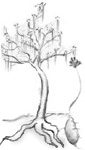
 The home page of the plant
family Moringaceae The home page of the plant
family Moringaceae
The home page of the plant
family Moringaceae The home page of the plant
family MoringaceaeThanks for visiting the Moringa Home Page! It will introduce you to the remarkable range of vegetative and floral morphology in the family, which consists of only one genus, Moringa. This page will show you:
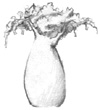 Massive trees with bloated water- storing trunks and small radially symmetrical flowers. |
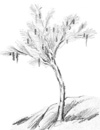 Trees with a
tuberous juvenile stage and cream to pink slightly bilaterally
symmetrical flowers |
Trees,
shrubs, and herbs of NE Africa The eight Moringa species found in northeast Africa span the whole range of life form variation found in Moringa. All but M. peregrina are endemic to northeast Africa, that is, found nowhere else on earth .These species are tuberous adults or tuberous juveniles maturing to fleshy-rooted adults; colorful, bilaterally symmetrical flowers |
| M. drouhardii Madagascar | M. concanensis mostly India | M. arborea NE Kenya |
| M. hildebrandtii Madagascar | M. oleifera India | M. borzianaKenya and Somalia |
| M. ovalifolia Namibia and extreme SW Angola | M. peregrina Red Sea, Arabia, Horn of Africa | M. longituba Kenya, Ethiopia, Somalia |
| M. stenopetala Kenya and Ethiopia | M. pygmaea N Somalia | |
| M. rivae Kenya and Ethiopia | ||
| M. ruspoliana Kenya, Ethiopia, Somalia |
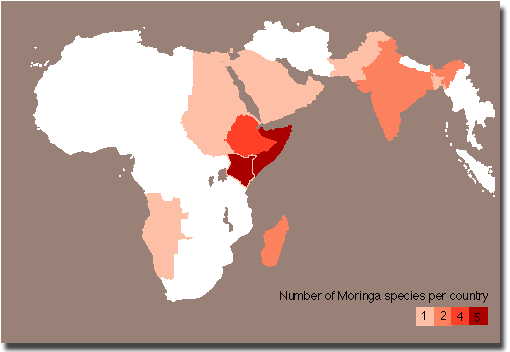 The first map shows Africa, Madagascar, and parts of Asia, including
Arabia and India. Countries in which Moringa occurs are shaded
in
color. The lightest shadings indicate that only one species of Moringa
is found in that country, while darker colors denote countries with
two, four, or five species. Moringa species almost always grow
in stands, only rarely occurring singly, and no species have been found
to occur sympatrically (to grow together in the same habitat at the
same spot).
The first map shows Africa, Madagascar, and parts of Asia, including
Arabia and India. Countries in which Moringa occurs are shaded
in
color. The lightest shadings indicate that only one species of Moringa
is found in that country, while darker colors denote countries with
two, four, or five species. Moringa species almost always grow
in stands, only rarely occurring singly, and no species have been found
to occur sympatrically (to grow together in the same habitat at the
same spot).
Arabia and
India: 3
slender trees
The three species that occur in the Red Sea area, Arabia, and the
Indian subcontinent are all slender trees.
This group includes the family's best-known and most economically
valuable species, M. oleifera. Now
cultivated in all the countries of the tropics, M. oleifera M. concanensis is mainly from India
and Pakistan, barely reaching into Bangladesh. M. peregrina has the widest range of
all, growing from the Dead Sea area sporadically along the Red Sea
coasts to northern Somalia and around the Arabian Peninsula to
the mouth of the Persian Gulf. seems to be native to
subhimalayan India.
Southern
Hemisphere: 3 bottle trees
The three species restricted to the southern hemisphere are all bottle trees. Namibia and Angola in
southwestern Africa are home
to M. ovalifolia, while M. drouhardiiand M. hildebrandtii are endemic to
Madagascar.
Moringa
diversity is highest in the Horn of Africa
With nine species,the Horn of Africa is the center of Moringa
diversity and include a variety of
life forms. Eight of the species found here are endemic (occur
nowhere
else). M. peregrina is found in northern Somalia, Arabia, and
the
Red Sea coasts north to the Dead Sea.
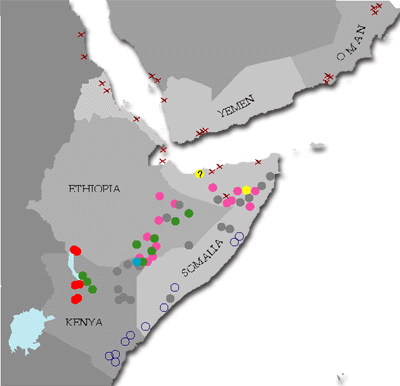
| Horn of Africa map legend | ||
| red x's | M peregrina | |
| yellow dots | M. pygmaea | |
| gray dots | M. longtituba | |
| pink dots | M. ruspoliana | |
| green dots | M. rivae | |
| blue circles | M. borziana | |
| red dots | M. stenopetala | |
| turquoise dot | M. arborea | |
Our patchy understanding of Moringa distribution in the Horn of Africa highlights how little-studied the dry lowlands of this area are. Two species, M. pygmaea and M. arborea, have only been seen twice each. M. stenopetala is widely cultivated but only known from five localities in the wild. M. ruspoliana has been collected by botanists less than 20 times since its discovery in the late 1800s. The full distribution and range of variation of M. rivae is still very murky, and the type locality of M. borziana hasn't been visited since the discovery of the species in the early 1900s. Even the relatively familiar species M. longituba is full of puzzles in its variation, distribution, and seasonal activity. The lack of documented Moringa localities in the extreme eastern point of Ethiopia is almost certainly due to a lack of exploration of the area, rather than a lack of Moringa.
The densest concentration of Moringa species is in Mandera District, in the extreme northeast of Kenya, where M. arborea, M. longituba, M. rivae, and M. ruspoliana can be found, though the species do not grow intermingled with one another.
Moringa
is apparently absent from Socotra, the large island off the Horn of
Africa
home - people - research - images of the dry tropics - exploration - acknowledgements
Instituto de
Biología, Universidad Nacional Autónoma de México
Circuito Exterior s/n, Ciudad Universitaria
Copilco, Coyoacán A. P. 70-367
C. P. 04510, México, D. F.
MÉXICO
(52) 55 5622-9127
fon (52) 55 5555-1760 fax
molson@ib.unam.mx